Three electrolytes, three jobs your body separates
It usually starts on a normal day: you finish a workout and feel both thirsty and oddly “puffy,” or you wake up with a dry mouth after a salty dinner and can’t tell if you need water, salt, or something else. The frustrating part is that the signals overlap—cramps, low energy, headache-y pressure, and sluggish digestion can all show up in more than one situation—so it’s easy to reach for the wrong fix.
One reason is that your body doesn’t treat “electrolytes” as one bucket. Sodium tends to act like a volume knob for the fluid outside your cells, shaping how much water you hold and what your pressure and thirst feel like. Potassium is more of an inside-the-cell balancing partner, tied to the electrical “reset” that helps muscles and nerves fire normally. Magnesium works in the background, supporting that signaling and energy handling—so when it’s off, the discomfort may feel vague before it feels obvious.
In real life, routines tug these in different directions. Sweating and water-heavy rehydration can leave you feeling washed out, while processed, salt-forward meals can make a “tight” or swollen day feel like dehydration. And if produce is inconsistent, potassium and magnesium may lag quietly until the pattern repeats enough to notice.
Sodium: the volume knob for fluid and pressure
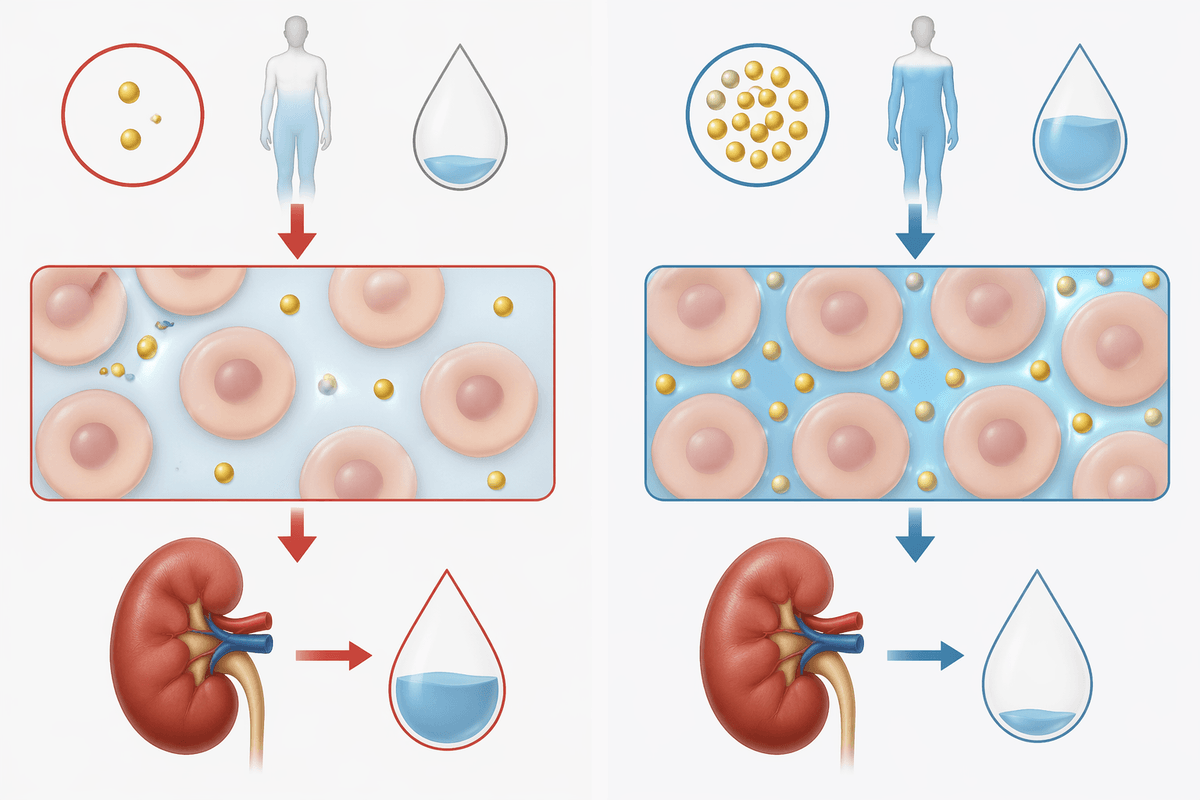
You notice it when your rings feel snug in the morning, yet your mouth still feels dry—like your body can’t decide whether it’s holding water or begging for it. That’s often the “volume knob” effect: sodium tends to influence how much fluid stays in the space around your cells, which can change thirst, how often you pee, and that vague sense of pressure that shows up as a headache or a heavy, swollen feeling.
After a sweaty workout, a big water-only refill can sometimes leave you oddly flat: not exactly thirsty, but not restored either. With less sodium available to help keep fluid where it’s useful, some people notice lightheadedness on standing, a drop in workout pop, or frequent urination that seems to undo their rehydration. It’s inconsistent, because the same person can swing the other way on a salt-forward day.
A salty meal can pull water along with it, so “puffy” can masquerade as dehydration, and chugging water may briefly soothe the dry mouth while the pressure-y feeling lingers. Sodium isn’t just about saltiness—it’s about where the water ends up and how steady that outside-the-cell reservoir feels from hour to hour.
Potassium: the electrical reset that steadies rhythm
It can feel like your muscles “forget” how to let go. You finish a run, sit down, and a calf or foot starts to grab—not the deep soreness of training, but a twitchy, jumpy tightness that comes and goes. Sometimes it shows up with a fluttery awareness of your heartbeat, or with fatigue that’s sharper than you’d expect from the effort.
That’s where potassium tends to matter, because it’s heavily involved in the electrical reset that helps nerves and muscles fire, then relax, then fire again. It also helps balance fluid inside cells, so when potassium runs low relative to your day—heavy sweating, lots of processed food but not much produce, or repeated “water only” refills—cells may not handle that on-off signaling as smoothly. It can resemble “not enough salt” or “not enough magnesium,” especially when cramps and low energy travel together.
And it rarely announces itself in a clean, one-time way. More often it’s a pattern: workouts feel slightly more brittle, recovery feels uneven, and the same hydration routine that worked last month suddenly feels off.
Magnesium: the quiet helper behind energy and relaxation
Sometimes it’s not a cramp so much as a stubborn “can’t fully unwind” feeling. You lie down after a normal day and your legs buzz, your eyelid twitches, or sleep comes but doesn’t feel restorative. The next morning you’re not clearly sick or clearly sore—just flat, a little wired, and oddly sensitive to small stressors.
That’s the kind of fog magnesium can sit behind. Magnesium helps enzymes handle energy (so muscles can do work without feeling as wasteful), and it supports the signaling that lets a muscle contract and then release. When magnesium is lagging, the signal may still fire, but the “off switch” can feel less reliable—showing up as tightness, twitching, or a clenched, restless quality rather than a dramatic cramp.
Constipation or slower motility can show up alongside fatigue, and it’s easy to blame water or salt alone. But magnesium status can be inconsistent—sweat, alcohol, stress, and habitual low-produce days can quietly stack up until the pattern becomes hard to ignore.
Why symptoms overlap and mislead your interpretation

The tricky moment is when the “same” symptom keeps changing costumes. A headache after a salty dinner can feel like dehydration, while the next day you’re peeing often and still feel tight and swollen. It’s easy to label all of it as “low electrolytes,” even though your body may be reacting to where water is sitting—outside cells versus inside them—more than the total amount you drank.
Cramps are where the overlap really misleads. Sodium shifts can make you feel washed out and lightheaded after sweating, but that drained feeling can also show up when potassium inside cells is lagging and muscles don’t reset cleanly. Magnesium adds another layer: you might not get a classic cramp at all—just twitching, restless legs, or a wired fatigue that makes recovery feel strangely uneven.
Digestion muddies it further. Constipation can travel with low fluid outside cells, but it can also appear when stress, alcohol, or low-produce stretches quietly pull magnesium down. When signals cluster, “more of one mineral” can seem logical, yet still miss what’s actually shifting.
When a sensible fix creates unexpected discomfort
You take the obvious step: you start salting your post-workout water, and for a day or two you feel steadier. Then a new annoyance shows up—your stomach feels unsettled, your hands look a little fuller, or you wake up thirsty again and can’t tell whether the fix worked or backfired. It’s an especially common frustration when the original symptom was real, but the context has already changed by the time you respond to it.
One reason a “sensible” fix can feel wrong is that sodium mostly affects fluid outside your cells. Add more sodium on top of a salt-forward day and you may pull more water into that outer space, which can read as pressure, puffiness, or a lingering headache even if you’re technically well-hydrated. Meanwhile, if potassium intake hasn’t kept pace—less produce, lots of packaged meals—the inside of cells may still feel under-supported, so muscles can stay twitchy or cramp-prone despite the extra salt.
Magnesium can complicate it in a different direction. If you reach for magnesium to calm cramps or sleep, some forms can loosen stools or make digestion unpredictable, and that can leave you feeling “dehydrated” the next day even when what really changed was gut fluid and timing. Each adjustment can temporarily shift the others, so the body feedback you’re reading may be about distribution and tolerance, not a simple “more is better” problem.
Patterns that change needs over time and context
A week can make the signals feel like they belong to different people. One day your usual salty lunch leaves you with a tight, pressure-y head and a thirst that never quite resolves; another day the same meal feels fine, but your workout turns twitchy and your legs won’t settle later. What changed wasn’t necessarily your willpower or your “hydration”—it may have been the background context: how much you sweated, how much plain water you chased it with, and whether potassium- and magnesium-rich foods showed up consistently enough to keep the inside of cells feeling stable.
That’s why patterns matter more than single episodes. Processed-food weeks tend to keep sodium high while potassium lags, so you can swing between “puffy” and “washed out” depending on your water intake and sweat loss. Add alcohol, travel, poor sleep, or a few hard sessions and magnesium demand may feel louder—more restless legs, more uneven recovery, more constipation that makes you think you’re simply behind on fluids. The body’s feedback is noisy: frequent urination can mean you’re overdoing water, but it can also show up when your usual balance is temporarily shifted.
If a symptom keeps repeating in the same setting—cramps late in long workouts, headaches after salty dinners, or constipation after stressful weeks—it’s often less about finding a forever supplement and more about noticing what your routine reliably pulls up or drains down. The “missing piece” can change with season, training block, and diet stretches, and that’s why the most useful clue is often the context the symptom returns in.