Travel isn’t indulgence, it’s preventive health
I paused on a bench outside baggage claim, rereading my own day-by-day spreadsheet while the carousel clacked and a family zigzagged past with a stroller. On paper, the trip looked “efficient”; in the terminal’s glare, it suddenly felt like a fall-risk obstacle course. The moment was small, but it clarified the real question: is this plan building health, or just spending money and energy?
For older travelers, “preventive health” doesn’t have to mean a red-eye and a heroic itinerary. The better comparison is between a trip that nudges you into steady movement, daylight, and mild problem-solving—versus one that compresses too much into too few days and replaces sleep with logistics. Travel can be a structured way to get more steps than at home, more varied terrain than a treadmill, and more reasons to stay socially engaged than a routine week. The novelty helps, but novelty plus fatigue can tip into stress, missed meals, and sloppy footing.
This framing works best for someone who plans months ahead and wants 7–12 days: long enough to settle, short enough to recover. It’s less convincing if the journey itself is punishing (tight connections, long security lines, late hotel check-ins) or if you’re forcing “must-see” pacing. If you’re choosing between two trips, the healthier bet is often the one with fewer transit days and a calmer middle—even if it looks less impressive on a map.
What the newest studies actually show
At 6:40 a.m., I had three browser tabs open—one hotel cancellation policy, one airline seat map, and one study abstract—and it was the “methods” section that made me hesitate. The research that gets quoted as “travel keeps you young” often isn’t a neat experiment; it’s closer to a careful comparison of people who travel versus people who don’t. That detail matters when you’re deciding whether a 10-day itinerary is health-supporting or just expensive exertion.
Recent reviews generally land in the same place: tourism participation tends to cluster with better well-being in older adults, partly because it bundles movement, purpose, and social contact into one package. A study using Health and Retirement Study data found leisure travel participation was associated with lower loneliness and depression and better cognitive function—useful, but still correlational (healthier, wealthier, more mobile people also travel more). If you want the most “believable” interpretation, it’s not that airports are magic; it’s that trips can increase the same protective behaviors we already trust: light-to-moderate activity, social engagement, and mentally engaging routines.
The limiting evidence shows up where your worries live: sleep and stress. Large wearable-based analyses suggest travel—especially across time zones—can disrupt sleep for days, which is a poor trade if you’re already managing balance, blood pressure, or mood. So the “healthier” trip type in the data tends to look less like a grand tour and more like a paced stay: fewer transit days, fewer time zones, and enough downtime that the novelty doesn’t steal your sleep.
Layer one: Movement without the gym
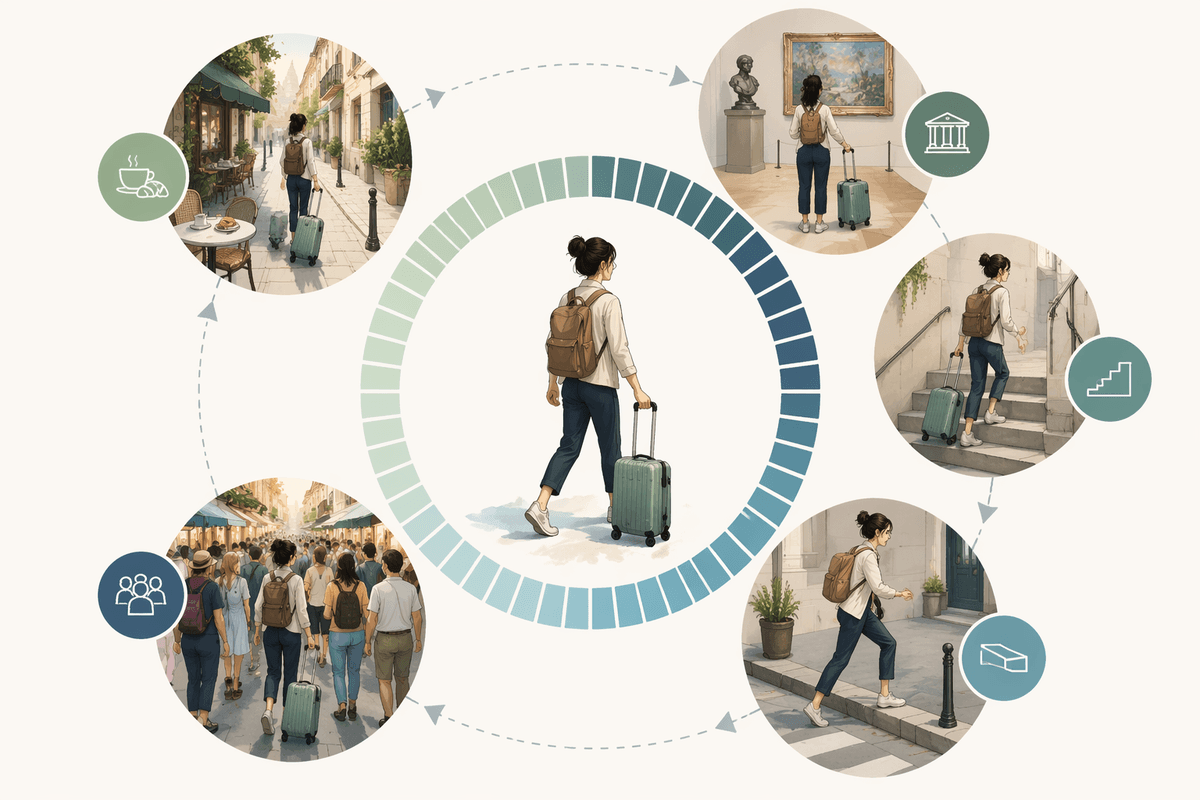
On day two in Lisbon, I hesitated at the top of a short cobbled lane near Chiado, watching other people take it like it was nothing. My phone said it was a “9-minute walk,” but the grade and the slick shine of the stones made it feel closer to a decision than a distance. I took the long way down—flatter, busier, less charming—and my knees quietly thanked me for it.
This is the underappreciated “movement layer” of travel: you can collect a week’s worth of light-to-moderate activity without ever entering a gym, but only if your route choices cooperate. Walking to breakfast, standing in a museum, climbing a few flights when the elevator is slow—those minutes add up more reliably than a heroic hike you only manage once. The trade-off is that travel-walking is uneven: more stop-and-go, more crowd flow, more awkward curbs and luggage, which can be harder on balance than a smooth neighborhood loop at home.
For a 7–12 day trip, the timing factor that matters most is how you spend the first 48 hours. If you arrive stiff and under-slept, a “just push through” day tour can turn movement into a fall-risk rehearsal. This approach works best for travelers who plan one anchor activity per day (a market, a waterfront path, a single major sight) and build in a deliberate reset—an early dinner, a sit-down café, a hotel close enough that you can bail out without feeling like you failed.
Layer two: Novelty that trains the brain
At 9:15 a.m. in a small Lisbon bakery, I froze for a beat at the counter—my rusty Portuguese, a line behind me, and a pastry case that suddenly looked like a test. I pointed, asked a question anyway, and felt my brain “wake up” in a way it rarely does at home. It was a tiny moment, but it landed differently than a crossword: higher stakes, more senses, more feedback.
This is the cognitive layer travel can deliver when it’s not overcaffeinated chaos: novelty that forces light problem-solving. Reading an unfamiliar transit map, navigating a museum layout, or choosing between two streets when the GPS drifts can work like gentle mental resistance training—more like learning a new routine than memorizing facts. The novelty can flip into overload fast: too much noise, too many micro-decisions, and suddenly you’re not “stimulated,” you’re depleted (and that’s when missteps and missed meals show up).
What seems to work best for a careful 7–12 day trip is controlled novelty: one “new brain” task per day, not ten. Pick a neighborhood you can learn well enough to stop relying on your phone, then branch out in short loops—market in the morning, quiet museum after lunch, familiar route back before late-day fatigue. If a choice adds pressure (night transfers, confusing stations, rushed timed-entry), it may be the wrong kind of challenge; if it adds curiosity without a penalty, it’s probably the right one.
Layer three: Social and purpose effects

I remember standing just outside the Time Out Market entrance around 7:10 p.m., watching the crowd compress as if the doors were narrowing. I had a reservation window elsewhere and the familiar urge to “make it worth it” tugged hard, but my feet were already sending early warnings. I stepped aside, texted a friend back home, and realized the calmer choice wasn’t laziness—it was pacing for the part of travel that actually changes you.
The social layer isn’t just being around people; it’s having small reasons to show up. A walking tour where the guide learns your name, a language class with a predictable start time, even a recurring café order can do more for mood than a museum you rush through alone. The social plans introduce friction: meeting points, crowd flow, and the pressure of not wanting to be “the slow one.” For many older travelers, the sweet spot is structured-but-light contact—two planned group moments per week—rather than nightly dinners that steal sleep.
Purpose matters, too, and it doesn’t have to be lofty. Choosing one “contribution” activity—church service, choir rehearsal, volunteer morning at a community garden, a paid craft workshop where you’re producing something—tends to feel different than pure consumption. It works especially well on days 4–9, when novelty starts to fade and motivation can wobble. If the option requires late-night transit or slick streets afterward, pick a daytime version; the benefit evaporates when the logistics feel risky.
Where plans go wrong for older travelers
I stared at a timed-entry confirmation on my phone—10:30 a.m., “no late arrivals”—while the hotel elevator crawled down from the sixth floor and my knee felt a little stiff from yesterday’s stairs. The plan assumed I’d move like a version of myself that sleeps perfectly and never needs a bathroom break. That gap between a clean itinerary and a real morning is where older-traveler trips start to unravel.
Most failures aren’t dramatic; they’re cumulative. One long transit day (early alarm, bright terminals, low hydration) can steal the next two mornings, which is a rough trade if your “health benefit” is supposed to come from steady walking and good sleep. Over-optimizing can backfire, too: the cheaper hotel that’s “only” a 20-minute uphill walk becomes a nightly negotiation, and the money saved gets spent on taxis—or on fatigue. Crowds amplify this: slow museum lines and packed metros turn “light activity” into stop-and-go balance work.
What tends to work better is designing for graceful failure. Build one movable block each day (a flexible lunch, an optional loop) so a slow start doesn’t force risky rushing. Put your “must-do” on days 3–7, not day 1, and treat evening plans as weather-dependent—heat, slick sidewalks, and dim lighting all raise the cost of being out late. If you’re choosing between two itineraries, pick the one you could still enjoy at 70% energy; that’s usually the one that pays you back.










![How to Become an Investor [Exactly What It Takes]](static/image/2026/07/14/2a4c5f88-5ccc-423a-b75c-d6c25c492ab7.png)